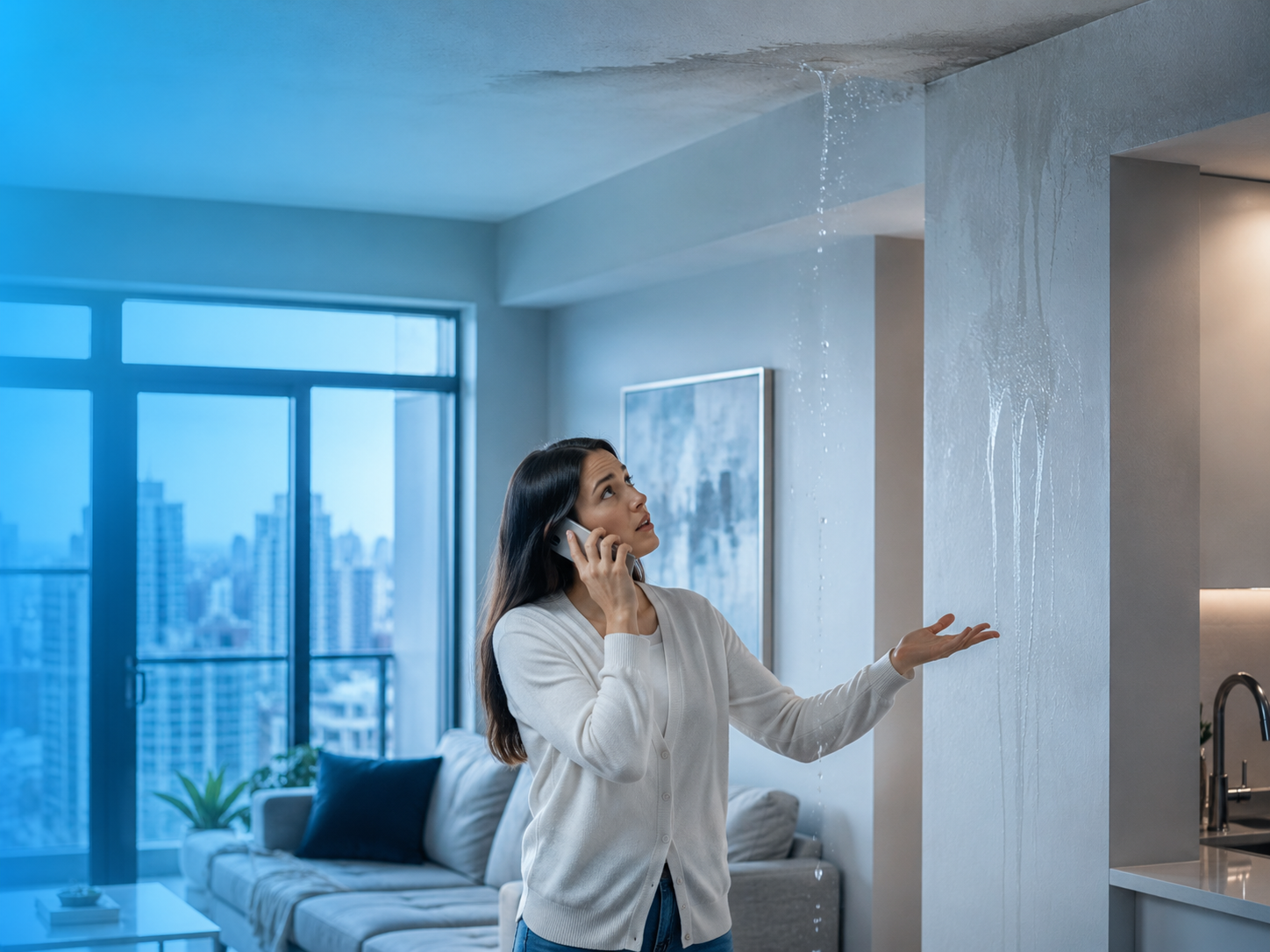
Does condo insurance cover water damage from a neighbor in Calgary? Usually yes, and your own condo policy is normally the first place to report damage inside your unit, even when the water came from upstairs. The neighbour’s insurer does not automatically pay simply because their dishwasher, toilet, or supply line was the source. Their liability coverage becomes relevant if negligence is established and an insurer pursues recovery.
An overnight leak can involve three different policies before the ceiling is dry. Your unit-owner policy can cover your interior, betterments, belongings, and temporary living costs. The condo corporation master policy can cover insured building components and common property. The neighbour’s liability policy may respond if the neighbour did something careless, such as ignoring a known leak, and is legally responsible.
Alberta adds another question. If damage or repair costs are connected to an owner’s actions, inaction, tenant, or guest, the corporation may be able to levy a chargeback under its bylaws and the current Condominium Property Act process. That is not the same as your ordinary policy deductible, and the board must follow notice and decision requirements. This guide explains who pays first, what Calgary condo insurance covers, what can be excluded, and how to handle a condo water damage claim without agreeing to the wrong bill.
Whose Insurance Pays When a Neighbor’s Leak Damages Your Condo?
Quick answer: Your own condo policy usually responds first to insured damage inside your unit. The condo corporation master policy handles insured building and common property. The neighbour’s liability policy pays only when the neighbour is legally responsible, often after your insurer investigates and seeks recovery.
Start with the damage, not the blame. If water from the suite above ruins your upgraded flooring, furniture, and electronics, your policy has direct coverage relationships with you and can begin adjusting the insured loss. You should not have to prove negligence before protecting your property. You pay your deductible, document the damage, and let the insurers investigate the source and responsibility.
The corporation policy enters when water damages property the corporation is required to insure, such as common walls, shared systems, or the standard unit described for the building. Alberta’s Condominium Property Act and Condominium Property Regulation establish the corporation-versus-owner insurance framework, while the condo plan, SIUD, bylaws, and master policy decide the precise boundary in your building.
The neighbour’s liability coverage is a third layer, not the default first cheque. A sudden appliance failure can happen without negligence. If the evidence shows the neighbour ignored repeated warnings, left a running fixture unattended, or failed to take reasonable action after discovering a leak, your insurer may seek reimbursement from the neighbour or their insurer through subrogation. That recovery happens between insurers and should not delay your initial notice of loss.
Key Difference: The corporation policy covers insured building and common property. Your personal condo policy covers your unit interior, betterments, belongings, living costs, and owner-specific assessment exposure. The neighbour’s liability policy matters only when legal responsibility is established.
What Water Damage Does Your Calgary Condo Insurance Actually Cover?
A unit-owner policy is built for sudden and accidental losses inside your condo. In the claim files we review, the strongest water claims have a clear event, immediate photographs, prompt mitigation, and a current record of what was damaged. The following coverages do different jobs within the same claim.
How Your Unit Interior and Betterments Are Covered
Your policy can cover insured unit components and improvements above the corporation’s standard unit. Depending on the building documents, that may include drywall, flooring, cabinetry, counters, fixtures, and renovations you paid for. The Standard Insurable Unit Description matters because the master policy may restore only builder-standard finishes. Your betterments limit pays the difference between that baseline and the unit you actually own.
How Your Personal Belongings Are Covered
Contents coverage responds to furniture, clothing, electronics, rugs, artwork, and other belongings damaged by insured water. Settlement is subject to the contents limit, deductible, and any special category limits. Replacement-cost wording is more protective than actual cash value because it pays the cost of a comparable new item rather than its depreciated value. Keep photographs and receipts for high-value property where possible.
How Additional Living Expenses Work If Your Unit Is Unlivable
Drying, mould prevention, and reconstruction can make a condo unsafe or impractical to occupy. Additional living expenses coverage can pay the extra cost of temporary accommodation, meals above your normal spending, storage, and other necessary expenses after a covered loss. Save every receipt and ask how long the coverage lasts and what total limit applies before choosing a temporary rental.
How Loss Assessment Coverage Protects Your Share of the Deductible
Loss assessment or deductible-assessment wording can protect you when the corporation allocates an insured loss, master-policy deductible, or eligible chargeback to owners, but these terms are not interchangeable on every policy. Triggers and limits vary. Match the wording to the corporation certificate and use the dedicated guide to loss assessment coverage for the deeper shared-loss explanation.
What Water Damage Will Your Condo Policy Not Cover?
Water damage is not one peril. Coverage depends on how quickly the water escaped, where it came from, and which endorsements you bought. A sudden supply-line rupture is usually insured. Moisture that seeped for months is usually not. The following gaps are the ones to look for on your own declarations page and wording.
Gradual leaks and poor maintenance. Damage from a slow leak, worn seal, deteriorated grout, corroded pipe, or problem you knew about and did not repair is normally excluded. The policy covers accidents, not the cost of maintaining the unit. Staining, rot, or mould growth that developed over time can show an adjuster that the damage was gradual.
Ground water and seepage. Water that moves through a foundation, floor, or wall from saturated ground is often excluded unless a broader water endorsement specifically includes it. Do not assume an overland-water or sewer-backup line covers every form of water entry.
Sewer and drain backup. Water or sewage rising through drains is commonly excluded from the base policy and added through a sewer-backup endorsement. Lower-floor and basement units should pay particular attention to the available limit and deductible.
Water sub-limits. A policy can cover the event but cap one part of the payout. A water-damage package, betterments coverage, mould remediation, or contents category may carry its own limit below the headline policy amount. A large contents limit does not raise a separate water sub-limit automatically.
Mould beyond covered remediation. Mould directly resulting from a prompt, insured water loss may receive limited treatment within the claim, while long-term or preventable mould is generally excluded. Report the leak quickly and follow professional drying instructions so an insured event does not become a maintenance dispute.
The corporation’s costs without matching assessment protection. Your ordinary unit coverage does not automatically pay every assessment or chargeback from the corporation. The cause must fit the endorsement, the amount must be valid, and your chosen limit must be high enough.
Damage you cause to another unit. Your property coverage repairs your property. A claim that you negligently damaged a neighbour’s unit is handled under personal liability, which is a separate coverage with its own investigation. For a wider exclusions review, see what your condo insurance does not cover.
Can the Condo Corporation Make You Pay Its Deductible in Alberta?
It can levy an eligible chargeback when the corporation’s bylaws allow it and the current statutory process is followed. Alberta changed the procedure in February 2026. A board must conduct due diligence on responsibility, provide written notice of the proposed chargeback within the required period, describe the incident and estimated amount, and give the owner at least the prescribed response time. If the board proceeds, it must pass a resolution and issue a statement of chargeback.
The amount is limited to the lower of the actual cost the corporation incurred to rectify the issue or the corporation’s insurance deductible, with the deductible amount capped at $50,000. The Government of Alberta also states that the corporation does not need to file an insurance claim before recovering an amount within that framework. Owners can challenge a chargeback through the available appeal or dispute process, subject to deadlines.
This is more accurate than saying any leak originating in your unit automatically makes you pay regardless of fault. The bylaws, evidence, conduct of the owner or occupants, notice, and board resolution all matter. A sudden failure with no act or omission may be treated differently from a leak ignored after repeated warnings. Common-property sources such as a roof, shared mechanical room, or corporation-maintained pipe also change the analysis. Send any proposed chargeback to your insurer immediately and do not concede responsibility before the facts and wording are reviewed.
Important: Alberta’s current chargeback rules require written notice, an opportunity to respond, and a board resolution. The amount can still reach the lower of actual repair costs or the corporation deductible up to $50,000, so keep your assessment protection aligned and forward every notice promptly.
How Loss Assessment or Deductible Assessment Coverage Absorbs the Chargeback
The insurance fix is not merely carrying some assessment coverage. It is carrying the right form, trigger, and limit. Ask whether the policy covers the corporation deductible, unit contingency, and broader loss assessments, and whether water carries a separate limit. Compare the endorsement with the current master certificate. A $10,000 default can leave a large gap against a $50,000 water deductible, while a matched limit can turn an eligible five-figure demand into a manageable insured claim.
Which Policy Responds to Each Type of Condo Water Damage in Calgary?
The source, damaged property, negligence evidence, and building documents decide the route. The table is a decision guide, not a substitute for your policy or legal advice.
| Leak Scenario | Whose Policy Responds First | Your Likely Out of Pocket | Key Note |
|---|---|---|---|
| A Neighbour’s Toilet or Dishwasher Overflows Into Your Unit | Your Condo Policy for Insured Unit Damage; Neighbour Liability Only If Responsibility Is Established | Your Deductible, Often Roughly $500 to $1,500 as an Estimate | Your Insurer May Seek Recovery Through Subrogation |
| Your Supply Line Fails and Damages Your Unit and the Unit Below | Your Policy for Your Property; Master Policy for Insured Building Property; Liability Reviewed for Damage to Others | Your Deductible Plus Any Valid Chargeback Not Covered by Assessment Protection | Current Alberta Notice and Decision Rules Apply |
| Water Enters From a Roof, Hallway, or Shared Mechanical Room | Corporation Master Policy for Insured Common-Property Origin, With Your Policy for Owner Property as Needed | Your Personal Deductible May Apply to Your Belongings or Betterments | Common-Property Responsibility Changes the Chargeback Analysis |
| A Pipe Bursts Inside a Shared Wall | Depends on Whether the Pipe Is a Unit Component or Common Property | Varies by the Policy That Covers the Pipe and Damaged Property | Condo Plan, SIUD, Bylaws, and Maintenance Duty Define the Boundary |
| A Hidden Leak Causes Damage Over Several Months | Often Excluded as Gradual Damage or Maintenance | Potentially the Full Repair Cost | Sudden and Accidental Is the Key Coverage Test |
Deductibles and limits above are illustrative. Your declarations page and the corporation certificate control. Report first and let the adjusters determine allocation rather than waiting for every party to agree on blame.
Do Calgary Condo Owners Really Need Extra Water Damage Coverage?
Most owners should at least price sewer backup, adequate betterments, and assessment protection. The right package changes with building age, unit position, and occupancy.
Owners in Older Beltline and Bridgeland Buildings
Older walk-ups and high-rises in the Beltline and Bridgeland can have stacked plumbing, dated supply lines, and multiple units below one source. That increases the number of properties a single leak can affect. Owners should confirm water sub-limits, betterments value, and a deductible-assessment limit that reflects the actual corporation certificate.
Top-Floor Versus Lower-Floor and Basement Units
Top-floor owners may face roof-origin questions, while lower units receive water from more suites above and carry greater sewer-backup exposure. Unit position does not decide coverage by itself, but it helps identify which endorsements and limits deserve priority. Lower-floor owners should not confuse inter-unit leakage with sewer backup because they are separate perils.
Owners Who Rent Their Unit Out
A tenant-occupied unit needs landlord condo wording, rental-income protection, and suitable liability and assessment limits. The tenant’s policy covers their belongings and liability, not the landlord’s betterments or lost rent. Tell the insurer before occupancy changes, since an owner-occupied form may not respond correctly after the unit becomes a rental.
How Much Does Condo Water Damage Coverage Cost in Calgary?
Price varies by unit, building, claims history, and limits. The figures below are broad planning estimates based on current Calgary condo quote patterns, not fixed rates and not a substitute for a quote. The key comparison is not only premium. It is the annual cost of the endorsement versus a water loss or assessment that can reach five figures.
| Coverage or Endorsement | What It Does | Typical Calgary Annual Estimate | What to Check |
|---|---|---|---|
| Base Condo Unit-Owner Policy | Covers Insured Unit Property, Contents, Liability, and Living Expenses | Roughly $300 to $850, With Higher-Risk Units Above This Range | Betterments, Contents, Deductible, and Assessment Defaults |
| Loss or Deductible Assessment Coverage | Helps Pay an Eligible Corporation Deductible or Shared Insured Assessment | Often Roughly $20 to $100 as an Add-On Estimate | Match the Limit and Trigger to the Master Certificate |
| Water and Sewer Backup Endorsement | Adds Sewer and Drain Backup Protection Commonly Excluded From Base Coverage | Often Roughly $40 to $150 as an Estimate | Separate Limit, Deductible, and Lower-Floor Exposure |
| Broader Water Package or Higher Sub-Limit | Expands Selected Water Coverage or Raises a Capped Amount | Often Roughly $50 to $250 as an Estimate | Covered Sources, Mould Limit, and Exclusions |
Current quote data shows that even ordinary Calgary condo premiums vary widely. Use one consistent set of limits when comparing options. A lower premium can simply reflect a missing endorsement or smaller assessment limit rather than a better value.
What Raises or Lowers Your Calgary Condo Water Coverage Cost?
Building Age and Plumbing Condition
Older piping, repeated building losses, and complex shared systems can increase both premium and deductible exposure. Updated supply lines, monitored leak detection, and documented maintenance can improve eligibility, though no device removes every risk.
Your Claims History and Deductible Choice
Prior water claims can raise pricing or narrow terms. Choosing a higher deductible can reduce premium but leaves more cash to fund at claim time. Select an amount you could comfortably pay during an emergency.
The Limits and Sub-Limits You Select
Higher betterments, contents, water, and assessment limits generally cost more. Check the small sub-limits before raising the headline amount, because the specific cap is often what controls a water claim.
Bundling Your Condo and Auto Coverage
Some insurers apply a multi-policy discount or coordinate deductibles when condo and auto coverage are placed together. Compare the combined coverage, not only the discount, and use the guide to bundling condo and auto insurance in Calgary for the separate decision.
How Do You File a Condo Water Damage Claim in Calgary?
A strong condo water damage claim in Calgary follows a clear sequence.
- Photograph and video the source, water path, damaged surfaces, and belongings before cleanup where it is safe.
- Stop further damage by shutting off water, moving property, and arranging emergency drying without making permanent repairs too early.
- Notify both the condo corporation or property manager and your broker or insurer promptly.
- Request the master insurance certificate, deductible, SIUD, bylaws, and incident report in writing.
- Keep damaged items unless they create a health hazard, and save every invoice and temporary-living receipt.
- Do not agree to pay a neighbour or the corporation before your insurer reviews responsibility and coverage.
- Let the insurers manage subrogation and allocation while you maintain a written timeline of every contact.
If the board sends a proposed chargeback, note the response deadline immediately and forward the entire package. The same evidence that supports your water claim can also help answer the corporation’s allegation.
What Should Every Calgary Condo Owner Do Before a Leak Happens?
- Confirm your deductible-assessment or unit-contingency limit against the current $50,000 statutory ceiling and master deductible.
- Add or confirm sewer-backup and any broader water endorsements that fit your unit position.
- Read every water sub-limit and deductible on your declarations page.
- Keep the SIUD, bylaws, and corporation insurance certificate with your personal policy.
- Maintain a photo inventory of contents and betterments, including renovation receipts.
- Know the unit water shutoff and the building’s after-hours emergency contact.
- Review the match again whenever the corporation changes insurers or deductibles.
Bottom Line: The right mix of unit coverage, water and sewer backup protection, and properly matched assessment limits turns a neighbour’s leak from a three-policy argument into a claim with a clear first step.
Protecting Your Calgary Condo From a Neighbor’s Water Damage
Does condo insurance cover water damage from a neighbor in Calgary? Your own policy usually responds first to insured damage inside your unit, the corporation policy handles insured building and common property, and neighbour liability depends on proven responsibility. The expensive gaps are gradual damage, missing water endorsements, and assessment limits that do not match the master deductible. Keep your building documents current, report water immediately, and let the insurers investigate fault. Preparation gives you a clear route before the ceiling starts dripping.
Review Your Calgary Condo Water Coverage With a Local Broker
A neighbour’s leak is easier to handle when your water sub-limits, assessment protection, and building documents already line up. Affordable Quotes Insurance can review your declarations page against the corporation certificate, SIUD, bylaws, and current deductible, then explain which policy should respond first in the scenarios your unit actually faces. You will know whether sewer backup is included, whether your betterments are valued properly, and whether a $50,000 chargeback would fit your limit. Request a review through our condo insurance in Calgary page or call 403-401-8876 for a clear, no-pressure coverage check before the next leak.
Frequently Asked Questions
Q. Does my condo insurance or my neighbour’s insurance pay for water damage in Calgary?
Your own condo policy is usually the first responder for insured damage inside your unit, including betterments, belongings, and additional living expenses. You report the loss, pay your deductible, and let your insurer investigate the source. The neighbour’s liability policy does not automatically pay because the water came from their unit. It becomes relevant when the evidence shows the neighbour was negligent or otherwise legally responsible, such as ignoring a known leak. Your insurer may then seek recovery through subrogation. The condo corporation master policy can also participate where insured building components or common property were damaged.
Q. Can my condo corporation charge me its insurance deductible if the leak was not my fault?
A chargeback is not automatic under Alberta’s current rules. The corporation’s bylaws must allow the charge, the board must investigate responsibility, and it must follow the written notice, owner-response, resolution, and statement process that took effect in 2026. The facts can include an owner’s actions or inaction and the conduct of a tenant or guest. A purely sudden failure with no responsible act may be treated differently, and common-property origin changes the analysis. Send any proposed chargeback to your insurer immediately, preserve the evidence, and respond within the stated deadline rather than assuming you must pay or that the demand is invalid.
Q. How much is the condo corporation deductible chargeback in Alberta?
Under Alberta’s current framework, the amount charged to an owner is limited to the lower of the actual cost the corporation incurred to rectify the issue or the corporation’s insurance deductible. The deductible side is capped at $50,000, and the corporation does not need to file an insurance claim before recovering an eligible amount. The actual bill can therefore be much lower, but it can still be substantial. Compare the corporation’s current water and general deductibles with your deductible-assessment or unit-contingency limit, because a small policy default may not match the building’s exposure.
Q. What is loss assessment coverage and do I need it on my Calgary condo policy?
Loss assessment coverage helps pay your share of certain insured losses, liabilities, deductibles, or shortfalls allocated by the condo corporation. Deductible-assessment and unit-contingency wording may handle related but more specific corporation-deductible exposure. Names and triggers vary by insurer, so carrying one small line called loss assessment does not prove every chargeback is covered. Most Calgary condo owners should compare both the cause of loss and the limits with the corporation certificate. The dedicated guide to loss assessment coverage for Calgary condo owners explains the shared-loss side in more detail.
Q. What should I do first when water from another unit damages my condo?
Protect people first, stop the water if you can do so safely, and document the scene with photographs and video. Notify the property manager or condo board and your broker or insurer promptly rather than waiting for the neighbour to accept responsibility. Move undamaged belongings, arrange emergency drying, and keep every invoice. Ask for the master insurance certificate, SIUD, deductible information, bylaws, and incident report. Do not agree to pay the neighbour or corporation before your insurer reviews the facts. A complete condo water damage claim in Calgary is easier to allocate when the source, timeline, and damage are recorded from the start.
Q. Will filing a condo water damage claim in Calgary raise my premium?
It may, but there is no fixed result. Claims history is one rating factor, along with the cause, amount paid, building history, and insurer’s underwriting rules. A single claim from another unit may be treated differently from repeated losses originating in your own unit, but no broker can promise that renewal pricing will remain unchanged. Report a significant insured loss promptly even if fault is uncertain. Delaying can allow damage to worsen and create a coverage dispute that costs more than a possible future premium change. At renewal, compare consistent limits so a lower price is not simply reduced water protection.
Q. Does condo insurance cover water damage if the leak came from the roof or a common area?
The corporation master policy generally takes the lead for insured building damage when water originates in common property such as a roof, hallway, or shared mechanical room. Your personal policy can still respond to your belongings, betterments, additional living expenses, or other owner property, so notify both the corporation and your insurer. A common-property source also changes the chargeback analysis because responsibility may sit with the corporation rather than an individual owner. The condo plan, SIUD, bylaws, maintenance duties, and policy wording determine the boundary, especially for shared-wall pipes and bare-land condominiums.